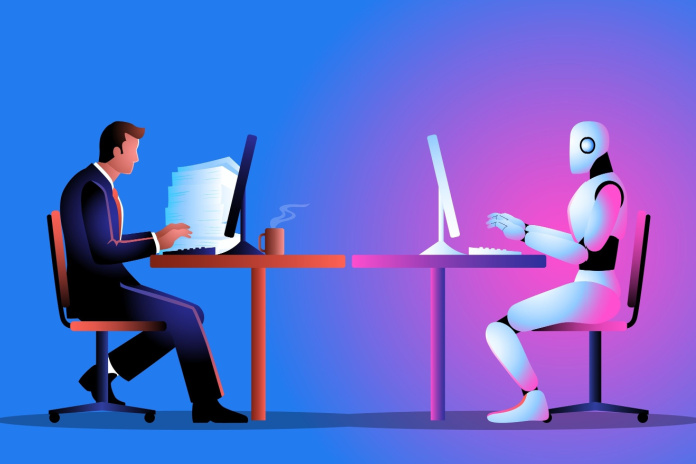

AI isn’t coming for jobs “someday.” It’s already changing who gets hired, promoted, or quietly pushed out. Here’s what the latest shifts in AI adoption mean for your career — and how to stay ahead before it’s too late.
The Career Shock No One Announced
For years, AI disruption was framed as a future problem — something executives and policymakers would eventually have to deal with. But over the past 12 months, that timeline collapsed. Quietly and quickly, AI has begun reshaping careers across industries, often without layoffs, headlines, or formal announcements.
Instead, the changes are subtler — and more dangerous. Job descriptions are shrinking. Teams are being “restructured.” Promotions are stalling. Entry-level roles are disappearing. Workers aren’t being fired en masse; they’re being made irrelevant.
What’s happening now isn’t a traditional employment crisis. It’s a career recalibration — one that’s already separating workers who are adapting from those who don’t realize the rules have changed. And the gap is widening faster than most people think.
What Actually Changed This Year
In 2024 and early 2025, AI adoption crossed a critical threshold. Tools like ChatGPT, Copilot, Gemini, and enterprise-level automation platforms moved from experimentation to daily operations inside companies.
According to reporting from major business outlets and earnings calls across tech, finance, consulting, media, and healthcare, companies are no longer asking if AI can replace or enhance human work — they’re asking how fast they can scale it.
The most revealing detail isn’t layoffs. It’s hiring freezes paired with “productivity gains.” Firms are producing the same output with fewer people — or growing output without growing headcount. Entry-level analyst roles, junior marketing positions, customer support teams, and even parts of legal and accounting departments are being consolidated or automated.
Executives are openly praising AI for “efficiency,” while quietly acknowledging it reduces the need for human labor. The result: fewer seats at the table, higher expectations for those who remain, and a job market that looks stable on the surface — but feels brutal underneath.
How AI Is Reshaping Careers in Real Time
The biggest mistake workers are making right now is assuming this disruption will look like past ones. It won’t.
AI isn’t eliminating entire professions overnight. Instead, it’s changing what counts as valuable work — and who gets rewarded for it.
First, junior roles are being squeezed. Tasks that once justified entry-level jobs — research, drafting, data cleanup, basic analysis — are now handled by AI tools in minutes. Companies still need humans, but fewer beginners. That makes it harder to break in and raises the bar for new hires dramatically.
Second, mid-career professionals are being tested in new ways. Experience alone isn’t enough anymore. Workers who rely on routine workflows, legacy tools, or “how it’s always been done” thinking are suddenly vulnerable. Meanwhile, peers who can pair judgment with AI execution are moving faster, producing more, and becoming indispensable.
Third, career progression is becoming uneven. Promotions aren’t disappearing — they’re becoming more selective. Managers are looking for people who can supervise AI outputs, make strategic decisions, and translate insights into action. Those who can’t risk stagnation, even if they’re competent.
There’s also a psychological toll. Workers report feeling constantly behind, unsure which skills matter, and anxious about being replaced by tools they don’t fully understand. Burnout isn’t just about workload anymore — it’s about uncertainty.
Perhaps most concerning: many people don’t realize they’re at risk until opportunities stop coming. No interviews. No raises. No stretch assignments. The career damage happens quietly, then all at once.
What Smart Workers Are Doing Differently
Despite the anxiety, this shift isn’t universally negative. In fact, some careers are accelerating faster than ever.
Workers who are thriving right now share a few traits. They treat AI as a multiplier, not a threat. They experiment early, even imperfectly. They focus less on mastering tools and more on understanding how tools change outcomes.
Experts in labor economics and future-of-work research agree on one thing: the most resilient careers will belong to people who combine three skills — domain expertise, critical thinking, and AI fluency. Not coding. Not prompt gimmicks. Fluency.
That means knowing when to trust AI, when to challenge it, and how to use it to improve decisions rather than just speed. It also means developing judgment — something AI still struggles to replicate.
Companies are already signaling this shift. Job postings increasingly emphasize “AI-assisted workflows,” “automation strategy,” and “human-in-the-loop” responsibilities. The message is clear: workers who can collaborate with machines will replace those who compete against them.
The next two years will likely bring more consolidation, fewer traditional career ladders, and more nonlinear paths. Freelance, hybrid roles, and project-based work may grow — not because companies love flexibility, but because AI makes modular labor easier to manage.
What to Watch — and What to Do Now
AI isn’t ending careers. But it is ending passive ones.
The most dangerous position today isn’t having the “wrong” job — it’s assuming your job will stay the same. The workers who win in this transition won’t be the loudest or the most technical. They’ll be the most adaptive.
Pay attention to how your role is changing. Notice which tasks are shrinking — and which decisions still require human judgment. Invest in skills that sit above automation, not inside it.
Because the career shock of AI won’t arrive with a headline or a pink slip. It will show up as silence. And by the time you hear it, others will already be ahead.